Study facts at a glance
Study population and duration: Thirty-one people with mild to moderate acne completed a 28-day, randomized, open-label, single-center split-face trial. The starting enrollment and attrition are not available in the abstract. Source 3
Treatments compared: Topical 2% supramolecular salicylic acid cream was compared with 5% benzoyl peroxide plus 0.1% adapalene gel, according to the title and methods. The objective contains a conflicting 0.01% adapalene figure. Source 3
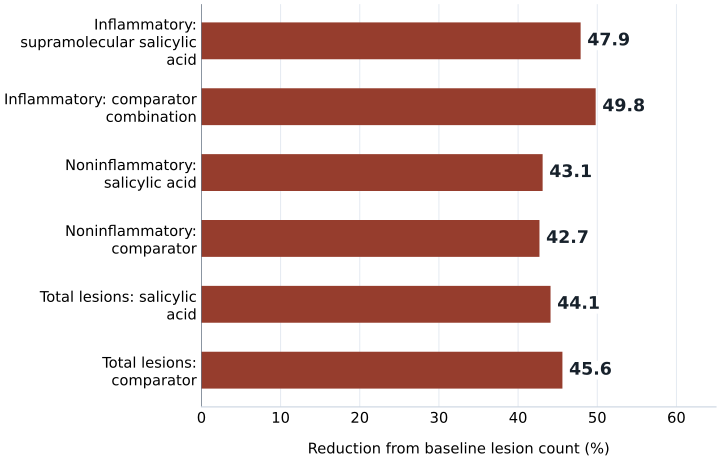
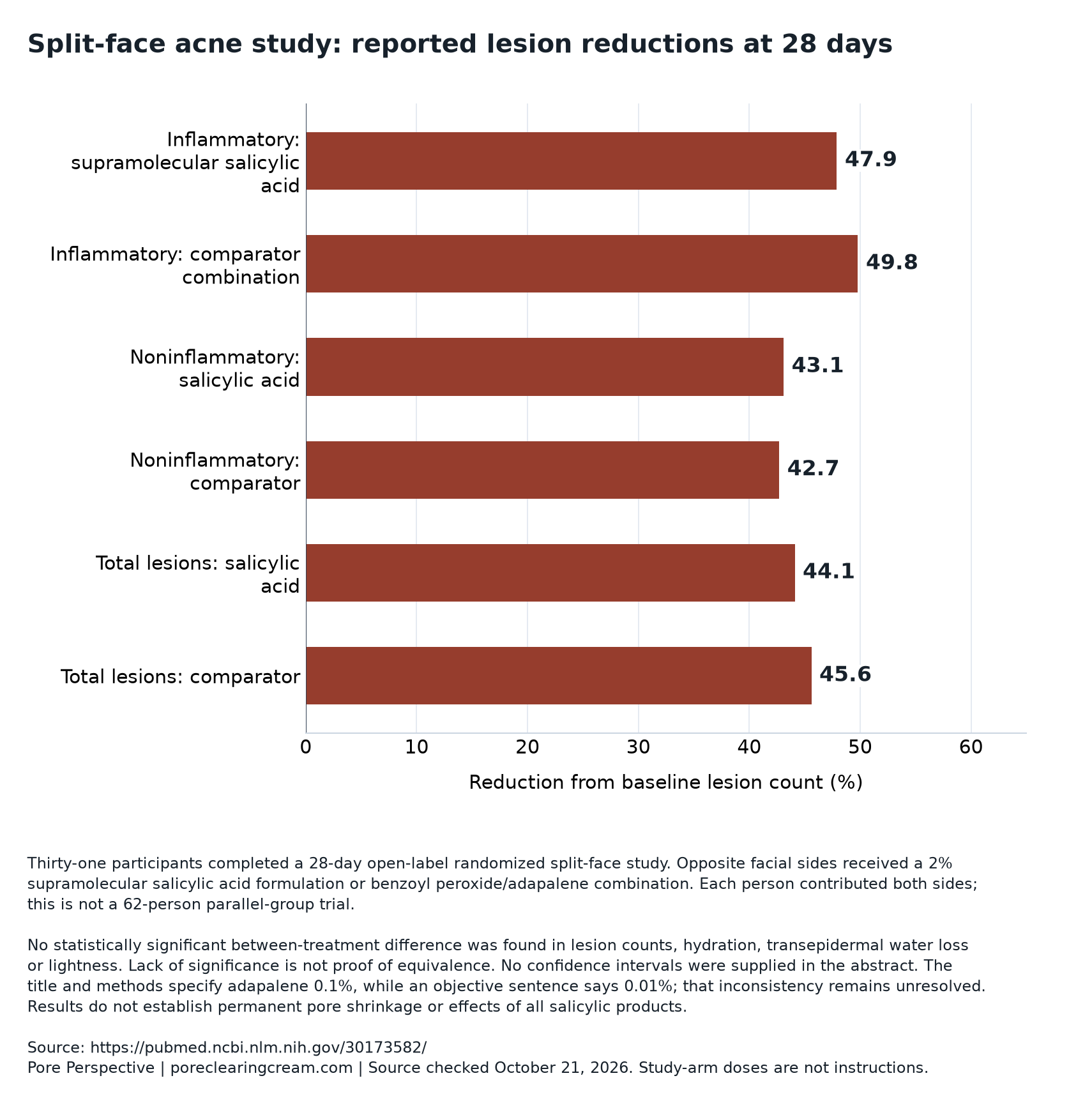
Total lesion change: Reported total lesion reductions at day 28 were 44.1% with salicylic acid and 45.6% with the comparator, a 1.5-percentage-point numerical difference. Source 3
Statistical interpretation: Between-treatment comparisons were not statistically significant. The abstract does not establish formal equivalence or provide confidence intervals. Source 3
Pore claims: Acne lesion counts, hydration, water loss, brightness, and erythema were assessed. These findings do not establish permanent pore shrinkage or pore closure. Source 3 Source 4
What a split-face comparison actually tests
Researchers enrolled people with mild to moderate acne and randomly assigned the two topical treatments to opposite facial sides. Investigators evaluated lesions and local side effects at baseline, day 14, and day 28. The abstract reports 31 completers. Because it does not give the initial enrollment, it cannot tell us how many people withdrew, why they withdrew, or whether incomplete participation affected the results.
The design is useful because each participant serves as their own comparison. Age, much of the skincare environment, and many person-level influences are shared across the two sides. But the sides are paired observations, not separate people: 31 participants do not become a 62-person trial. Facial asymmetry and treatment application still matter. The abstract does not provide enough statistical detail to evaluate how the paired measurements were analyzed or how missing observations were handled.
Read the underlying chart data: download CSV or download the source-labeled chart.
The formulation and comparator need their full names
The experimental treatment was a 2% supramolecular salicylic acid cream, described as a modified salicylic acid preparation. Its comparator was a gel combining 5% benzoyl peroxide with adapalene. These were topical study arms, not instructions for building a home regimen. The comparison evaluates complete formulations: it does not isolate salicylic acid from its cream vehicle or separate the contributions of benzoyl peroxide and adapalene.
There is an important reporting discrepancy. The title and methods identify adapalene at 0.1%, while the objective also contains a 0.01% figure. This article follows the title and methods when describing the comparator, without claiming independent full-paper confirmation. More broadly, the word supramolecular is not a license to transfer these results to every 2% BHA liquid, cleanser, compounded cream, or other formulation. A matching concentration alone does not establish a matching clinical effect.
The day-28 results, separated by lesion type
The investigators counted inflammatory lesions, reported as papules and pustules, as well as noninflammatory lesions. They also reported total lesion reductions. The indexed abstract does not identify a prespecified primary endpoint or an outcome hierarchy, so total lesions should not be presented as a confirmed primary endpoint. Keeping the categories separate matters: a result for all lesions does not mean every lesion category changed by the same amount.
At day 28, the comparator had a numerically larger reduction in inflammatory and total lesions, while salicylic acid had a slightly larger reduction in noninflammatory lesions. The table shows the actual scale of those differences. These are percentage reductions in counts, not percentages of participants who became clear. For readers sorting out which visible features are even acne lesions, the guide to blackheads and visible pores addresses a distinction that this trial does not resolve.
Reported lesion-count reductions at day 28; numerical differences are not proof of superiority or equivalence.
| Outcome | 2% supramolecular salicylic acid | 5% benzoyl peroxide plus adapalene |
|---|---|---|
| Papules and pustules | 47.9% reduction | 49.8% reduction |
| Noninflammatory lesions | 43.1% reduction | 42.7% reduction |
| Total lesions | 44.1% reduction | 45.6% reduction |
How to read a 44.1% reduction
A worked example helps distinguish count change from patient success. If a hypothetical facial side started with 50 lesions, a 44.1% reduction would represent roughly 22 fewer lesions, leaving about 28. A 45.6% reduction from the same starting count would represent roughly 23 fewer. These are illustrations using an invented baseline, not reconstructed trial data. The abstract does not supply the baseline counts or participant-level results needed to calculate actual remaining lesions.
Subtracting 44.1 from 45.6 gives a 1.5-percentage-point difference in reported total lesion reduction. It does not mean that 1.5% more people cleared their acne. Likewise, the inflammatory reductions differ by 1.9 percentage points, while the noninflammatory reductions differ by 0.4 percentage points in the opposite direction. Without individual data, these group-level results cannot reveal whether most participants improved similarly or whether improvement varied substantially from person to person.
Similar numbers do not establish interchangeable treatments
The abstract reports no statistically significant between-treatment differences for the lesion reductions. That finding means the reported analysis did not establish a difference under its statistical testing framework. It is not the same as proving the treatments equivalent. An equivalence or noninferiority claim requires a suitable design, an acceptable difference defined in advance, and estimates precise enough to evaluate that boundary. Those elements are not available in the indexed report.
Confidence intervals are also absent, so readers cannot inspect the range of treatment differences compatible with the data. With 31 completers, precision is a central unresolved issue rather than a technical footnote. The open-label design means treatment assignment was not concealed through blinding; that can affect expectations and potentially assessment or application behavior. Random assignment strengthens the comparison, but it does not remove every source of uncertainty. The authors’ characterization of the work as a pilot is therefore important.
Skin measurements answer different questions from pore photographs
Researchers measured skin water content and transepidermal water loss, or TEWL—the movement of water through the skin to the outside environment. They also measured lightness with an L* index and erythema, or redness, with an a* index. The abstract reports no statistically significant differences between facial sides in these measurements. It does not provide the numerical estimates or confidence intervals needed to judge the size or precision of any differences.
These measurements should not be substituted for an unmeasured cosmetic outcome. A lightness index is not a scar assessment; a redness index is not a complete inventory of irritation; TEWL is not pore diameter. Nor does the absence of a between-side difference prove that neither side changed from baseline. For the specific question of visible openings, whether pores can shrink requires a different evidentiary discussion. This trial supplies no reported measurement of permanent pore-size change, pore closure, or scar remodeling.
Four weeks leaves durability and tolerability unresolved
The 28-day observation period supports a short-term comparison. Although assessments occurred at day 14, the accessible abstract supplies the key percentage reductions at day 28, not a detailed numerical account of the earlier visit. It therefore cannot establish exactly when benefits began, how consistently they developed, or whether an early difference later disappeared. There is no reported follow-up after treatment ended, so persistence, recurrence, and longer-term maintenance remain unanswered.
Investigators assessed local side effects, but the abstract does not supply detailed adverse-event frequencies, severity distributions, or treatment-related discontinuations. The lack of significant differences in hydration, TEWL, and redness is relevant but narrower than a claim of no irritation. The unavailable enrollment denominator also prevents calculation of an attrition rate. Funding and sponsorship are not disclosed in the accessed abstract; their absence here should be understood as unavailable information, not evidence that the study had no sponsor.
Two longer studies tested different salicylic acid questions
A separate randomized, double-blind trial followed 37 volunteers for 12 weeks, comparing a cream containing 0.5% chloroxylenol plus 2% salicylic acid with 5% benzoyl peroxide gel. Reported inflammatory reductions were 62% versus 60%, and noninflammatory reductions were 56% versus 54%, respectively, without a statistically significant between-group difference. Erythema and photosensitivity were significantly less frequent with the combination at week 12, but the abstract gives no event counts. The combination-cream trial analysis examines why that is not evidence for salicylic acid alone.
Another randomized study enrolled 49 patients for 12 weeks and tested adding salicylic acid to clindamycin plus benzoyl peroxide. Its indexed abstract reports better lesion-count results with the addition, but does not provide effect sizes, confidence intervals, or the salicylic acid concentration. Mild to moderate transient dryness was more frequent with the added treatment. These studies support formulation-specific questions, not a pooled ranking: their vehicles, companion ingredients, comparisons, blinding, and follow-up differ. Longer observation does not make their outcomes interchangeable with the split-face trial.
Three studies involving salicylic acid, with different comparisons and evidentiary limits.
| Study | Design and comparison | Main interpretive boundary |
|---|---|---|
| Supramolecular salicylic acid | 31 completers; randomized, open-label split-face; 28 days; modified cream versus benzoyl peroxide/adapalene gel | Numerically close lesion reductions do not establish equivalence or pore shrinkage. |
| Chloroxylenol plus salicylic acid | 37 volunteers; randomized, double-blind; 12 weeks; combination cream versus benzoyl peroxide gel | Combination and vehicle effects cannot be attributed to salicylic acid alone. |
| Salicylic acid added to clindamycin/benzoyl peroxide | 49 enrolled; randomized, single-blind; 12 weeks; addition versus the base combination | Better reported counts came with more transient dryness; magnitude is unavailable in the abstract. |
Official acne labeling adds context, not trial confirmation
FDA’s OTC acne monograph lists salicylic acid at 0.5–2% and benzoyl peroxide at 2.5–10% among its ingredient conditions. Compliance depends on all applicable conditions, not concentration alone. The monograph is neither a clinical trial nor product-specific approval, and its acne uses concern lesions such as blackheads and whiteheads rather than permanent pore shrinkage. FDA’s cosmetic BHA background page likewise does not supply a precise pore-size benefit or validate every product marketed with exfoliation language.
Safety needs a separate lens. Labeling warns that combining topical acne medicines can increase dryness and irritation. FDA has also warned of rare serious hypersensitivity associated with some products containing salicylic acid or benzoyl peroxide; the responsible ingredient could be active, inactive, or both. Throat tightness, breathing difficulty, faintness, or swelling of the eyes, face, lips, or tongue warrant stopping the product and seeking emergency care. The historical spontaneous reports have no exposure denominator and cannot supply an incidence rate or a comparative risk for the trial formulations.
A pore-clearing offer needs evidence that matches the offer
Editorial interpretation: the useful purchasing question is not simply whether a label says 2% salicylic acid. It is whether the offered formulation, route, treatment duration, and promised outcome match the evidence being invoked. A four-week lesion-count comparison cannot document permanent cosmetic change, long-term benefit, or results from a different cream or oral product. The guide to pore-treatment claims provides a framework for separating ingredient plausibility from a demonstrated product outcome.
Editorial interpretation: service terms and clinical evidence should also remain separate. Readers considering a service can use the CoreAge Rx review or Likeness Rx review to check documentary terms such as what is included, pricing, and renewal provisions. Those links do not establish that either service supplies the studied formulation or reproduces its outcomes. This pilot trial offers no basis for evaluating a provider’s care quality, contract value, compounded products, or condition-specific results.
Questions about the evidence
Did the trial include 31 patients or 62?
It reports 31 completers. Each person received one treatment on one facial side and the comparator on the other, creating paired observations. Counting the sides as 62 independent patients would overstate the amount of independent information. The abstract does not report the original enrollment, so it also cannot establish the completion percentage or withdrawal rate.
Was salicylic acid proven as effective as adapalene?
No. The comparator combined adapalene with 5% benzoyl peroxide, so the study was not a comparison against adapalene alone. The reported reductions were numerically close and the between-treatment tests were not statistically significant, but the abstract does not establish formal equivalence. It also contains conflicting adapalene concentrations; the title and methods specify 0.1%.
Does a 44.1% reduction mean nearly half the participants cleared?
No. That figure describes the reported reduction in total lesion counts on the salicylic-acid-treated side, not a patient-clearance rate. A person can have substantially fewer lesions and still have active acne. The abstract does not provide the individual results or clearance categories needed to determine how many participants became clear.
Do the skin-barrier findings show that the cream caused no dryness?
No. The study found no statistically significant between-side differences in hydration or TEWL, but detailed adverse-event frequencies are unavailable. Those measurements do not capture every experience of dryness or irritation. A different trial adding salicylic acid to clindamycin and benzoyl peroxide reported more transient dryness, illustrating why tolerability must be tied to the particular formulation and regimen.
Can these findings support permanent pore-shrinking claims?
No. The reported outcomes concern acne lesions and selected skin measurements over 28 days, not permanent pore dimensions. The trial does not report a pore-size endpoint or observation after treatment ended. FDA’s acne monograph also addresses acne treatment rather than establishing permanent pore closure or a quantified cosmetic shrinkage benefit.
What this evidence supports
This randomized split-face pilot provides a useful short-term signal: a specific modified 2% salicylic acid cream was associated with lesion-count reductions numerically close to those of benzoyl peroxide plus adapalene among 31 completers. Its strongest contribution is that direct, within-person comparison—not proof of treatment interchangeability. The small sample, open-label assessment, unavailable confidence intervals, incomplete safety detail, and four-week duration leave meaningful uncertainty. For pore-focused readers, the dividing line is especially clear: fewer counted acne lesions are a measured outcome; permanent pore shrinkage is not. Larger, longer studies with transparent endpoint definitions and detailed tolerability reporting would help establish how dependable and durable the formulation-specific findings are.
Research access and limitations
Clinical analyses here rely on indexed primary study abstracts; full protocols, supplements, and complete trial reports were not reviewed. Official FDA material supplies regulatory and safety context, not confirmation of the trial’s findings. The split-face abstract contains an adapalene concentration discrepancy and lacks enrollment, attrition, confidence intervals, detailed adverse-event frequencies, and funding information.