What does the label establish about acne and rosacea?
The Epsolay label identifies adults with inflammatory lesions of rosacea as its indicated population. It does not extend that indication to acne, blackheads, pore diameter or every form of facial redness. The two registered studies concern moderate to severe papulopustular rosacea. Some registry outcome descriptions unexpectedly use acne terminology; that inconsistency does not turn them into acne trials or create an acne approval.
An ingredient search can obscure this distinction. Our Effaclar BPO review and PanOxyl Creamy Wash review concern their own products and records. Neither can lend its indication or instructions to Epsolay. If the underlying concern has not been identified, choosing between these names is not a substitute for a clinician’s assessment.
Which strength and formulation are being reviewed?
The narrative prescribing information describes encapsulated benzoyl peroxide at 5%, or 50 mg per gram. FDA product metadata also lists 5% for the matching prescription cream. However, the same DailyMed document’s structured ingredient field states 30 mg per gram. We have not reconciled that conflict. We report the narrative and FDA-listed strength without declaring a different marketed concentration or claiming to verify what a particular pump contains.
Encapsulation describes the preparation; it is not proof of freedom from irritation or superiority over another product. The label leaves the precise rosacea mechanism unresolved and says systemic exposure after Epsolay application was not assessed. Those limits matter when a formulation story sounds more conclusive than the clinical evidence actually is.
Who took part, and what was the comparison?
The label’s two randomized, double-blind trials compared Epsolay with vehicle cream over 12 weeks. They enrolled 733 adults with moderate or severe papulopustular rosacea. Entry required 15–70 inflammatory lesions and no more than two nodules. The label reports an age range of 18–85, with 73% female participants and 93% described as Caucasian. That is a specific study population, not a complete representation of everyone seeking facial treatment.
Trial 1, NCT03448939, and Trial 2, NCT03564119, both name Sol-Gel Technologies as the industry sponsor. The label and registry entries describe the same two studies; reading both does not supply independent replication. The comparator was vehicle, not an acne wash, another rosacea medicine or our sponsor’s product. These results cannot rank those alternatives.
What happened to inflammatory lesion counts?
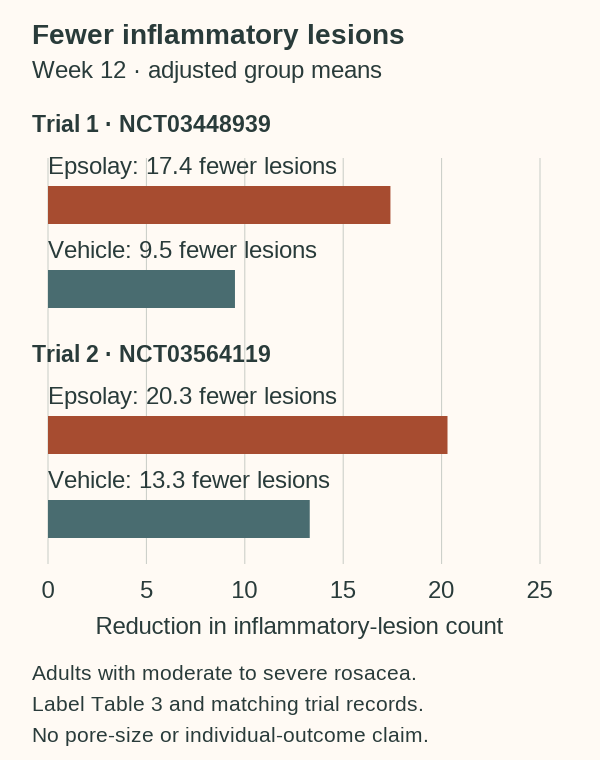
The four plotted values agree between label Table 3 and the corresponding registry outcomes. They are least-squares mean changes, meaning adjusted group estimates rather than a prediction for an individual. The chart shows reductions as positive lengths; the signed changes from the records remain in the table and downloadable CSV.
| Trial and randomized groups | Epsolay: signed mean change | Vehicle: signed mean change |
|---|---|---|
| NCT03448939: 243 / 118 | −17.4 lesions | −9.5 lesions |
| NCT03564119: 250 / 122 | −20.3 lesions | −13.3 lesions |
For Trial 1, the label prints an adjusted difference of −7.9 lesions, with a 95% confidence interval from −10.0 to −5.9. For Trial 2, it prints −6.9, with an interval from −9.0 to −4.9. We retain that second estimate rather than replacing it with subtraction of the rounded arm means. The captured records do not explain the mismatch. The intervals describe uncertainty around between-group estimates, not the range of outcomes every participant experienced.
Vehicle groups also improved. The relevant question is the comparison within each trial, not the active group’s change alone. These endpoints count inflammatory lesions; they do not measure pore diameter. Our pore-appearance guide explains why a different cosmetic outcome needs its own evidence.
Why do the investigator ratings differ between sources?
Investigator Global Assessment, or IGA, is a separate outcome. The label defines success as grade 0 or 1 with improvement of at least two grades. The registry describes grade 0 or 1 and reports imputation of missing observations. Its percentages differ from the label:
| Trial | Label: Epsolay / vehicle | Registry: active / vehicle |
|---|---|---|
| NCT03448939 | 47.4% / 20.7% | 43.5% / 16.1% |
| NCT03564119 | 49.2% / 28.2% | 50.1% / 25.9% |
Both use the randomized group sizes shown above. The saved sources do not establish why the rates differ. Different wording and missing-data methods are visible, but neither is a demonstrated explanation. We do not average the percentages, choose the more attractive result or multiply imputed rates into supposed observed responder counts. Agreement on lesion estimates does not resolve a different endpoint’s discrepancy.
What belongs beside the benefit figures?
The label warns about serious allergic reactions, irritation or contact dermatitis, and sensitivity to sunlight. It contraindicates use after hypersensitivity to benzoyl peroxide or a formulation component. Its patient information directs users to stop Epsolay and get immediate medical help for allergic symptoms including hives or severe itching, facial or throat swelling, breathing difficulty or throat tightness, and faintness or dizziness. These are not symptoms to dismiss as evidence that treatment is working.
The label’s selected adverse-reaction table uses 488 Epsolay recipients and 234 vehicle recipients. Application-site pain and redness each occurred in 11 versus two participants; itching and swelling also appear. Separately, week-12 tolerability was assessed in 455 Epsolay recipients, not everyone randomized. Dryness, itching, scaling and stinging or burning were graded in that subset. Those symptom assessments are not interchangeable with adverse-reaction counts.
The registry safety populations total 487 active recipients and 234 vehicle recipients. Trial 2 describes one participant assigned active treatment but analyzed with vehicle after receiving it; that does not fully reconcile the label’s pooled denominator. We retain each source’s population and do not create a new pooled reaction rate. None of these tables establishes a safety ranking against unrelated medicines.
What remains uncertain for a reader?
The studies excluded pregnant or breastfeeding participants and certain ocular-rosacea cases requiring antibiotics. Pediatric safety and effectiveness are not established in the label. Its pregnancy and lactation discussion contains data limits, not a blanket safety guarantee. Personal treatment decisions require the current supplied information and a clinician who knows the person’s circumstances.
The controlled comparison lasts 12 weeks. The label mentions a longer open-label safety extension, but that is not a controlled long-term efficacy comparison. We have not reviewed the full journal report, protocol or statistical-analysis-plan files, or FDA’s linked approval letter and review package. We also did not extract numerical results from the label’s figure images. Those boundaries prevent an apparent abundance of links from becoming a claim that every underlying analysis was audited.
How can this review help with the next question?
Epsolay has product-specific rosacea trial evidence, alongside warnings and record discrepancies that deserve attention. This article does not supply an acne regimen, predict an individual result or verify price, insurance coverage or pharmacy stock. A useful follow-up starts with the exact diagnosis, medicine and supplied label, then asks which outcome matters and how benefits and adverse effects will be assessed.
The claim-reading guide offers a broader way to separate a population, comparator and outcome. Here, the source check date is November 21, 2026; it does not make the older trials new. Their results were posted in December 2021. Individual source notes below distinguish record dates from this review’s access date.